Picture this: it's just past 7 AM, the air is thick with the smell of charcoal smoke and lemongrass, and a woman in a wide-brimmed straw hat paddles a wooden boat toward you, balancing a steaming pot of boat noodles on the bow. This is what a floating market in Bangkok actually feels like — and it's every bit as good as the photos suggest, if you know which market to visit and when.
Bangkok's floating markets aren't just a tourist attraction. They're what this city looked like before roads replaced its waterways. For centuries, the canals — or klongs — were Bangkok's highways. Vendors sold directly from boats, families set up stalls along the water's edge, and entire neighborhoods grew around their local canal market. Today, that tradition still lives on across seven markets in and around the city, each with its own personality, crowd, and food scene.
This guide cuts through the noise. Whether you're hunting for the best floating market in Bangkok, figuring out how to get from the city to Damnoen Saduak, comparing every floating market Bangkok has to offer, or trying to decide between a morning and an evening market — you'll find the answer here. If you're still building your wider itinerary, our full guide to things to do in Bangkok is a good place to start.
Which Floating Market in Bangkok Is Right for You?
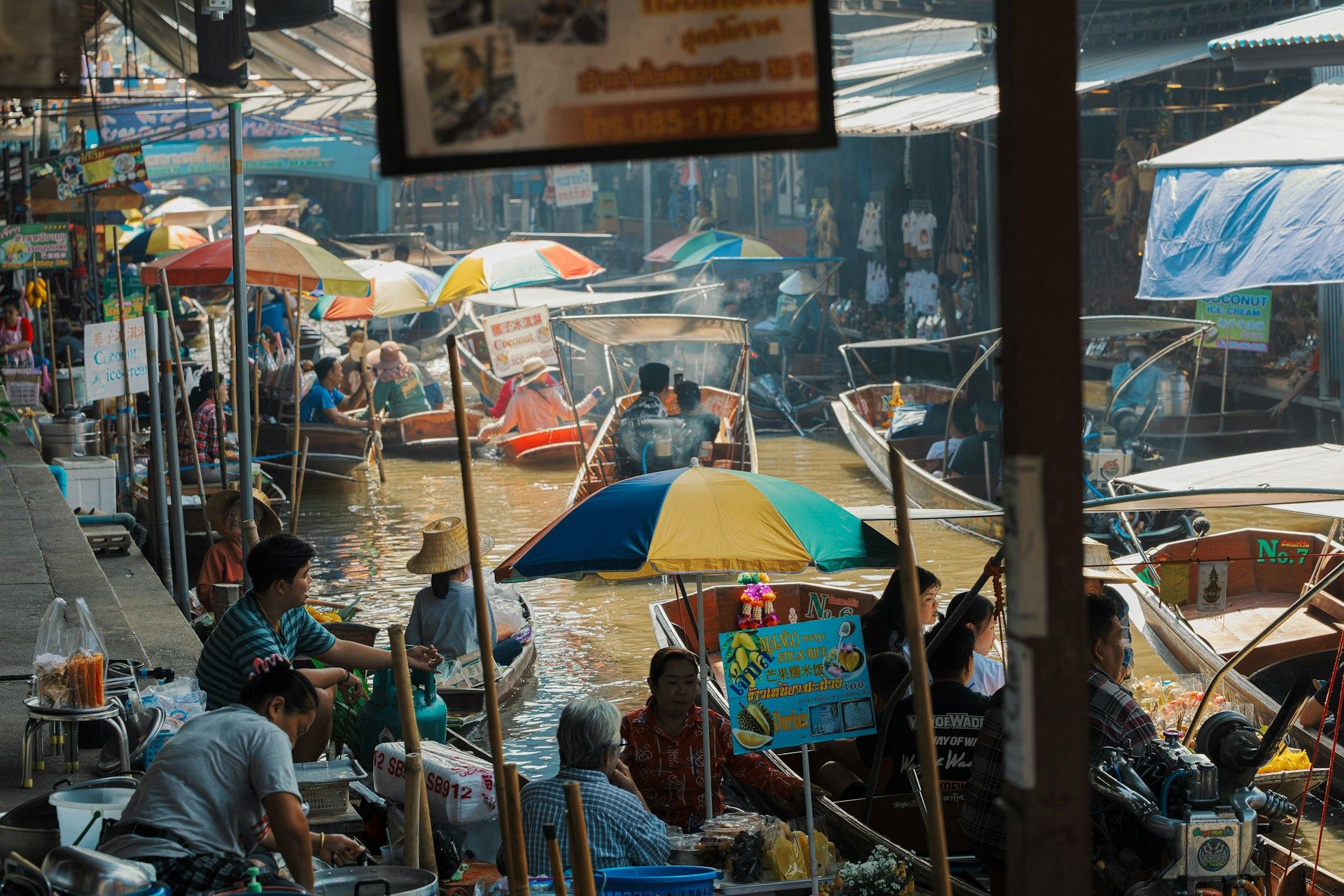
Before we list every market, let's do this differently. Most travel blogs give you a ranking. We're giving you a decision guide, because the best floating market in Bangkok depends entirely on your itinerary.
"I only have a morning and I'm staying in the city" → Head to Taling Chan or Khlong Lat Mayom. Both are open on weekends (Saturday–Sunday), reachable in 20–30 minutes from downtown, and packed with local families rather than tour groups.
"I want the classic floating market — boats, colors, the whole spectacle" → That's Damnoen Saduak. Arrive before 8 AM for the authentic experience. Yes, it's touristy after 9 AM. No, that doesn't mean you shouldn't go.
"I'm visiting on a Tuesday or Wednesday" → Damnoen Saduak is your only real option. It's the sole major market open daily — but go early. Authentic vendor activity wraps up by around 11 AM; after that it's souvenir boats only.
"I want seafood, evening atmosphere, and something memorable" → Amphawa, Friday through Sunday from 2 PM. Stay for the firefly boat tour after dark.
"I'm traveling with kids or elderly family and want something calm" → Bang Nam Pheung, tucked inside Bangkok's lush "green lung." Flat, easy to walk, community-run, and surrounded by cycling paths.
"I want to go somewhere most tourists haven't found yet" → Tha Kha or Ayothaya. More on both below.
Floating Markets in Bangkok: The Market-by-Market Guide
Damnoen Saduak Floating Market — The Iconic One
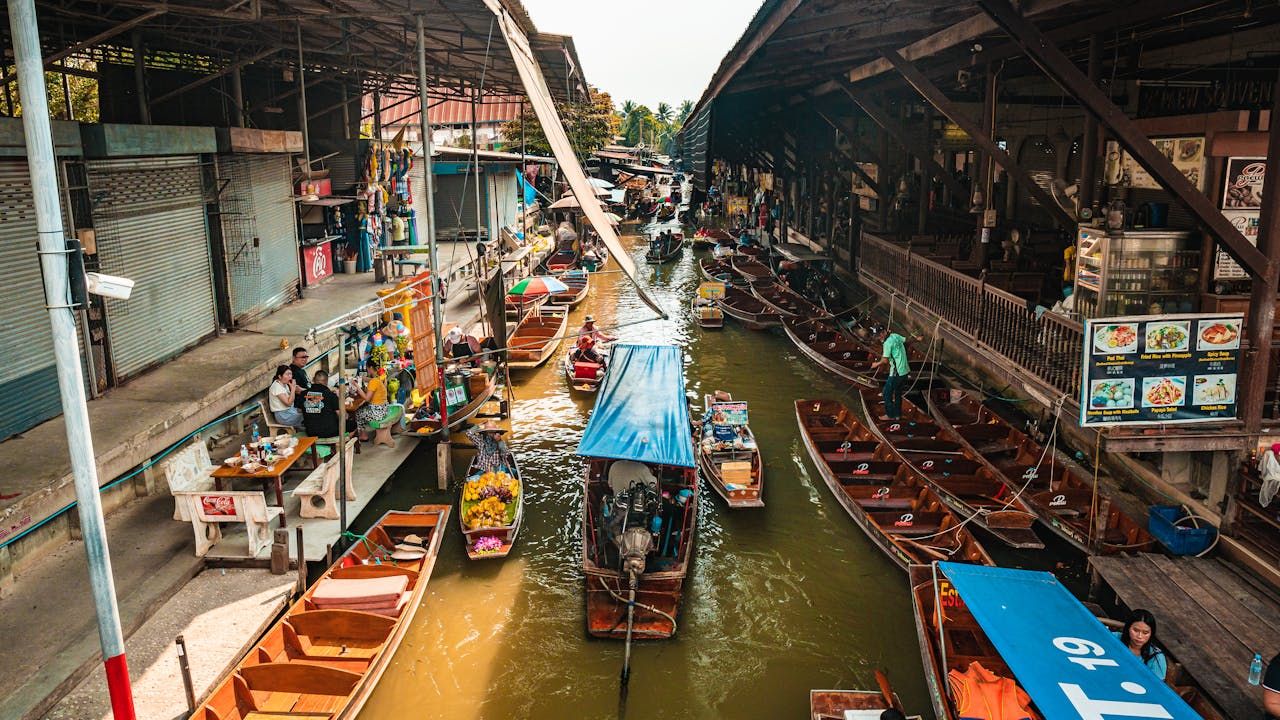
The market is open daily from 7 AM, though in practice the authentic floating action — the boats, the canal vendors, the vendors-trading-with-vendors scene everyone comes for — is largely over by 11 AM. After that it shifts to souvenir boat rides aimed squarely at tourists. If you're visiting midweek, plan to arrive well before 9 AM; a Tuesday afternoon visit will find mostly empty canals and closed food stalls. The canal network here is genuinely impressive: dozens of wooden boats navigate narrow klongs, vendors in traditional dress paddle from customer to customer, and the whole scene has a theatrical energy that's unlike anything else in Southeast Asia.
The honest caveat: After around 9:30 AM, tour buses arrive in force and the vibe shifts from authentic market to well-organized spectacle. That's not necessarily a dealbreaker — many visitors enjoy it — but if you want to see Damnoen Saduak at its best, the window is 7 AM to 9 AM. The golden morning light, the quieter canals, and the vendor-to-vendor trading that happens before the crowds arrive make for an experience that earns its reputation.
What to eat here:
Kuay Teow Reua (boat noodles) — the non-negotiable order. Rich, slightly sweet broth, served in small bowls from boats
Khanom krok — coconut pancakes, crispy on the outside and custardy inside
Mango sticky rice — ubiquitous, but the versions here are excellent
Coconut ice cream served in a coconut shell — perfect for the heat
Getting there: The easiest option is a guided day tour from Bangkok that includes hotel pickup, transport, and a boat ride through the market — starting from around THB 700–1,000 per person. This is also the most popular choice for a tour mercato galleggiante Bangkok among international visitors, since it removes all the transport logistics entirely. Independent travelers should head to the Southern Bus Terminal (Sai Tai Mai) to catch a minivan — expect to pay around THB 120–150 each way. Worth noting: minivans no longer depart from Victory Monument for long-distance routes like this one; the Thai government relocated them to the main bus terminals some years ago. For those wondering how to get to the mercato galleggiante Bangkok on your own (come arrivare without a guide), the Southern Terminal minivan route is straightforward — but plan your return before early afternoon when services thin out.
Best combined with: Maeklong Railway Market — see the combo itineraries section below.
Amphawa Floating Market — The Seafood Evening Market
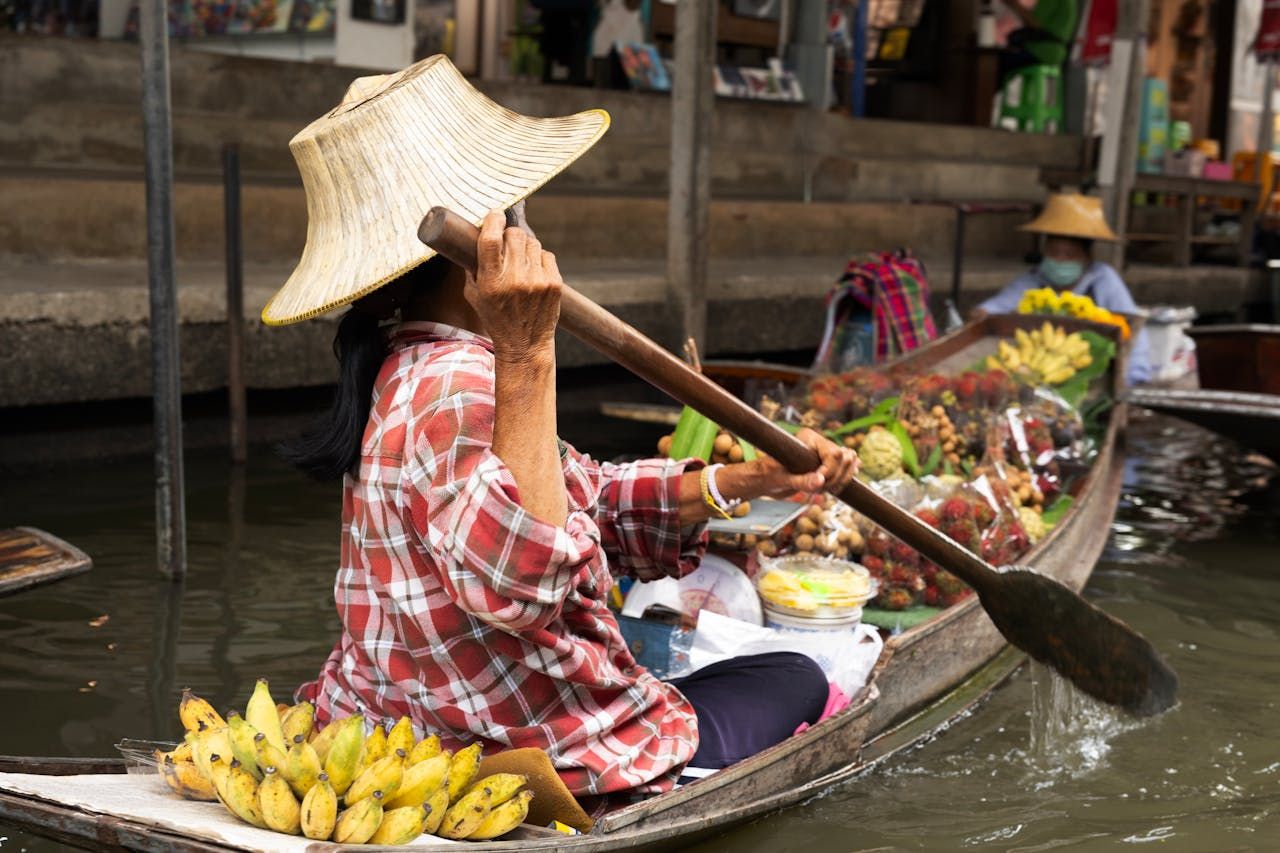
Amphawa is the most popular floating market near Bangkok for those who want something with more local character than Damnoen Saduak — and for many travelers, it turns out to be the more memorable experience. Located about 90 km from Bangkok near Samut Songkhram, it opens on Friday, Saturday, and Sunday afternoons (2 PM–9 PM), which gives it a completely different atmosphere from the morning markets.
As evening falls, the Mae Klong River lights up with wooden boats grilling seafood over charcoal, lanterns reflected on the water, and Thai families sitting along the canal banks eating together. There are no tour buses at this hour. The crowd here is overwhelmingly Thai locals from Bangkok who make the weekend trip, which tells you a lot about the quality of the food.
What to eat here:
Grilled squid and river prawns — ordered by weight, cooked on the boat in front of you
Thod mun pla (fishcakes) with sweet chili sauce — a must
Khanom Alua — a jellied Thai sweet you won't find at most markets
Pork dumplings and som tum (green papaya salad) for non-seafood eaters
The firefly tour: After dark, long-tail boats take passengers along the river's edge to watch thousands of fireflies lighting up the mangroves. It sounds like a tourist gimmick; it isn't. It's genuinely one of the most unusual things you can do in the Bangkok area.
Getting there: A 1.5-hour drive from Bangkok. Most visitors join an Amphawa evening tour that combines the firefly boat ride with transport — saving the hassle of organizing a return journey after dark. If you're going independently, plan your return trip before you leave: songthaews stop running early.
Taling Chan Floating Market — The Weekend Local Gem
Just 12 km from central Bangkok, Taling Chan is the floating market that the city's own residents actually go to on weekend mornings. Open Saturday and Sunday from 9 AM to 5 PM, it's the most accessible option if you want a genuine market atmosphere without committing to a long day trip.
It's smaller than Damnoen Saduak, but that's part of the appeal. Wooden platforms extend over the canal where vendors set up seafood grills, noodle stalls, and fresh produce boats. On weekend mornings there's usually live traditional Thai music, and the crowd — mostly Bangkok locals — gives the whole place an easy, unhurried energy.
What to eat: Boat noodles, grilled river fish, pad thai cooked on the canal-side, and freshly squeezed sugarcane juice. It's also one of the few markets where you can get a traditional Thai massage between courses.
Getting there: Bus 79 from the city center, or a taxi for around THB 150–200 from the BTS Bang Wa station — allow 15–20 minutes depending on traffic and which canal entrance you're heading to. If you're staying somewhere along the MRT Blue Line, the Bang Khun Non station is actually slightly closer to Taling Chan than Bang Wa, with about a 5–10 minute taxi from there. For the BTS, the quickest payment option is tapping directly with a contactless Visa or Mastercard, which most gates now accept. If you're planning to use Bangkok transit heavily, a Rabbit Card is still an option for the BTS Skytrain, though the transit payment landscape in Bangkok is shifting toward contactless bank cards — worth checking current options before you travel.
Khlong Lat Mayom Floating Market — The Food-First Market
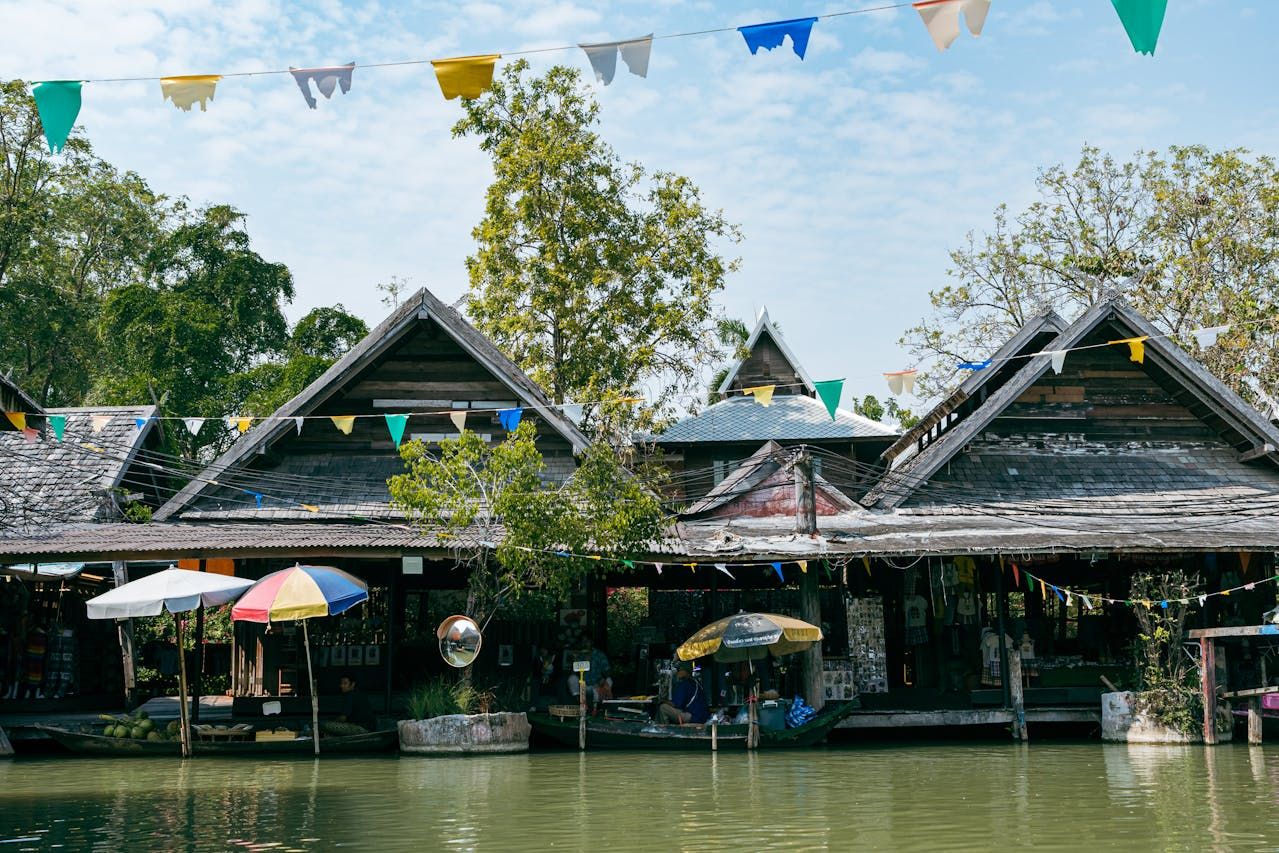
The "floating" element here is understated — a handful of boats along the canal, mostly selling plants, fruit, and fresh produce. The real market is on land, spread across a large shaded area of vendors, canal-side seating, and food stalls that rival anything in the city.
What to eat — specifically:
Pla chon pao (salt-crusted grilled snakehead fish) — find the row of half-barrel grills in the middle of the market. They cook hundreds at a time and the result is incredibly moist and flavorful. For first-timers: eat the meat inside, not the salt crust or skin — the crust is a cooking method, not a seasoning you consume
Kanom jeen (cold rice noodles with curry sauce) — a classic you'll find at almost every stall
Hoi tod (crispy oyster omelette) — one of the best versions in Bangkok
Fresh orchards fruit, bought by the bag
Getting there: BTS Skytrain to Bang Wa, then a 10-minute taxi (around THB 100–150).
Bang Nam Pheung Floating Market — The Eco Escape
Technically in Samut Prakan rather than Bangkok proper, Bang Nam Pheung sits across the Chao Phraya River inside Bang Krachao — a loop of land often called Bangkok's "green lung." Reaching it requires a short ferry crossing and then a walk or cycle through lush greenery, which means the journey itself becomes part of the experience.
Open weekends (Saturday–Sunday, 8:30 AM–5 PM), this community-run market emphasizes organic produce, handmade crafts, and local food over tourist souvenirs. The stalls are canal-side rather than boat-based, but the atmosphere is peaceful in a way that Bangkok's more famous markets can't match.
Unique to this market: After browsing the stalls, rent a bicycle or hop on an e-scooter tour to explore the rest of Bang Krachao — shaded paths through tropical gardens, traditional wooden houses on stilts, and the occasional temple tucked into the trees. It's a genuine half-day escape from the city.
Getting there: Ferry from Klong Toei Pier (near Sukhumvit), then bicycle rental or taxi from the pier. Klook's Bang Krachao e-scooter tour combines the market with a guided green-lung tour — recommended for first-timers.
Tha Kha Floating Market — The Hidden Gem
Tha Kha operates every Saturday and Sunday, and additionally on the 2nd, 7th, and 12th days of the lunar month — a traditional schedule it's kept for generations. With its growing popularity in recent years, the weekend opening is now reliable regardless of the lunar calendar, though the lunar dates tend to draw a slightly larger crowd of vendors and locals.
Positioned between two temples near Amphawa, the market sits inside a network of coconut plantations and narrow canals that look largely unchanged from decades ago. Elderly vendors barter over lotus stems, palm sugar is wrapped in banana leaves, and on some mornings, monks pass in wooden boats for the tak bat (alms-giving) ceremony. It's the closest thing in the Bangkok area to the floating market experience as it existed before tourism.
If your dates align: make the trip. Combine it with Amphawa for a full day on the canals.
Ayothaya Floating Market — History Meets Tradition
Located 80 km north of Bangkok in Ayutthaya, this is the only floating market that pairs a canal market experience with UNESCO World Heritage temples. Worth being upfront about: Ayothaya is a purpose-built, reconstructed market rather than an organically evolved one like Tha Kha or Amphawa. That's not a reason to skip it — the setting is beautiful, the food is good, and the period costumes add genuine colour — but go in knowing it's a curated experience rather than a centuries-old tradition. Open weekends and some weekdays, it's relaxed and easy to navigate.
The best way to visit is as part of a Bangkok–Ayutthaya day tour that adds the floating market as a morning or lunchtime stop before the temple circuit.
What's Open When — The Full Calendar of Floating Markets in Bangkok
Bangkok floating market opening hours are the most Googled question we see — and the most inconsistently answered. Here's a clean breakdown.
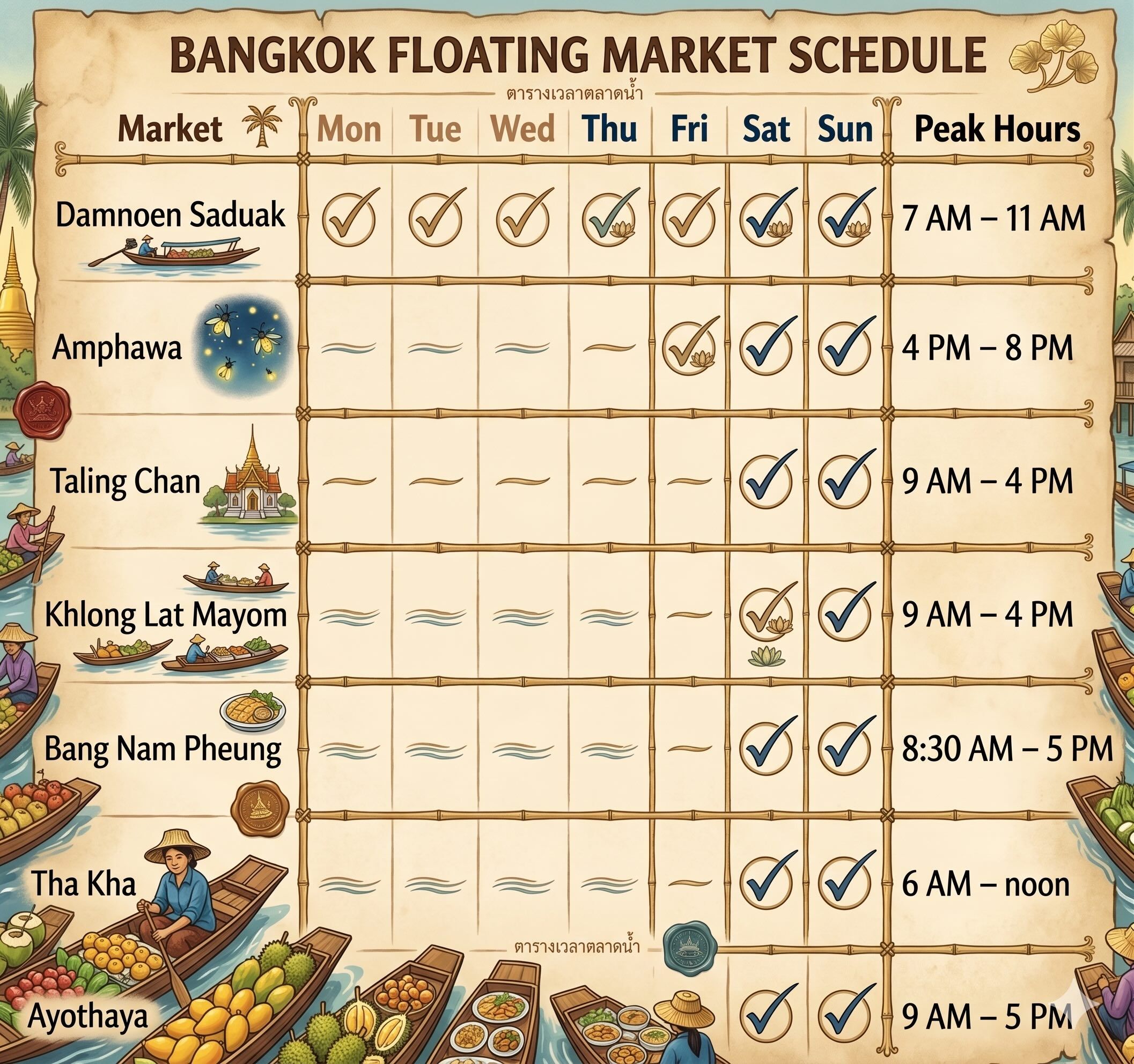
Key insight: If you're in Bangkok midweek, Damnoen Saduak is your only major option — but the clock is ticking. Book a weekday tour with early hotel pickup so you're on the canals by 7–8 AM, well before the 11 AM point when authentic activity gives way to souvenir boats.
How Much Does a Floating Market Trip Actually Cost?
Most guides give vague numbers. Here's what a realistic 2026 trip costs, broken down:
Damnoen Saduak (independent)
Minivan from Southern Bus Terminal (Sai Tai Mai): THB 120–150 each way
Boat ride through the market: THB 100 for a seat on a shared motorboat, or THB 300–500 for a private paddle boat
Food: THB 150–300
Total: approximately THB 570–1,000 per person
Damnoen Saduak (Klook guided tour)
Full-day tour including hotel pickup, transport, boat ride: from THB 700–1,000
Food not included but budget THB 150–300
Total: approximately THB 850–1,300 per person
The honest comparison: On paper, the independent route saves money. In practice, the guided tour departs early enough to guarantee a good arrival time, handles the bus terminal logistics (which can be confusing on first visit), and often includes add-ons like a coconut sugar farm stop. For first-timers, the time and stress saved is genuinely worth it.
Amphawa evening tour: THB 800–1,200 including transport and firefly boat, or you can budget THB 700–1,000 independently if you arrange your own transport both ways.
City markets (Taling Chan, Khlong Lat Mayom): The most budget-friendly option. Taxi from BTS Bang Wa: THB 100–150 each way. Food budget: THB 150–300. Total: under THB 600 per person.
Practical money tips:
Bring cash. Almost no boat vendors accept cards or QR codes.
Small bills — THB 20 and 50 notes — are useful for food stalls.
At tourist-heavy markets like Damnoen Saduak, souvenir prices start high. Polite counter-offers (smile, suggest 60–70% of asking) are expected and usually accepted.
Food prices are generally fair and non-negotiable — don't haggle over a bowl of noodles.
The Best Floating Market Combo Day Trips
Floating markets in Bangkok are almost always better combined with something else. Here are four proven combinations with hour-by-hour timing:
Combo A: Damnoen Saduak + Maeklong Railway Market (morning)
This is the most popular day trip from Bangkok, and for good reason — it pairs two of Thailand's most visually arresting experiences into a single morning.
5:30–6 AM — Depart Bangkok (hotel pickup with Klook tour, or catch minivan from Southern Bus Terminal)
7:30–8 AM — Arrive at Damnoen Saduak at peak morning hour; join a short canal boat tour
9:30–10 AM — Browse the stalls and eat before authentic activity winds down
11 AM — Drive 30 minutes to Maeklong Railway Market, where vendors set up stalls directly on active train tracks and fold everything away when the train passes through. Trains run at approximately 8:30 AM, 11:10 AM, 2:30 PM, and 5:40 PM — arriving around 11 AM puts you perfectly in line for the 11:10 pass. (Thai Railways can have minor timing adjustments, so it's worth a quick check at the station on arrival.)
1–2 PM — Return to Bangkok
Book the Floating Market + Maeklong Railway day tour on Klook — it handles all logistics and runs daily.
Combo B: Amphawa + Maeklong + Firefly Tour (afternoon–evening, weekends)
A later-starting, more leisurely version of Combo A — designed for travelers who'd rather sleep in and end the day memorably.
1–2 PM — Depart Bangkok
2:30 PM — Maeklong Railway Market (catch an afternoon train pass-through)
4 PM — Arrive at Amphawa; browse stalls, order grilled seafood from the boat vendors
6:30–7 PM — Sunset over the Mae Klong River
7:30–8 PM — Board a longtail boat for the firefly tour along the mangrove banks
9–10 PM — Return to Bangkok
Weekends (Friday–Sunday) only. This is the trip that people consistently describe as a highlight of their Thailand visit. If you're back in Bangkok by 10 PM with energy to spare, our roundup of the best bars in Bangkok has options for every mood — from rooftop views to low-key neighbourhood spots.
Combo C: Taling Chan + Bang Nam Pheung (city weekend day)
The best option if you want two markets, minimal travel, and no long highway drives.
9 AM — Arrive at Taling Chan (20–30 mins from downtown); eat, explore, take a short canal boat
12 PM — Ferry across the Chao Phraya to Bang Krachao
1–2 PM — Browse Bang Nam Pheung market
2–4 PM — Cycle or e-scooter through the green lung's garden paths and temples
4:30 PM — Back in the city
Both markets are local, unhurried, and mostly Thai-speaking — which makes this combination ideal for travelers who want something that feels genuinely off the tourist trail.
Combo D: Ayothaya Floating Market + Ayutthaya Temples (historical day trip)
The underrated combination. Most visitors do Ayutthaya for the temples and overlook the floating market entirely.
7–8 AM — Depart Bangkok by minivan or private car (80 km north)
9:30 AM — Ayothaya Floating Market; traditional central Thai dishes, period costumes, canal-side shopping
11 AM–4 PM — Ayutthaya's temple circuit: Wat Phra Si Sanphet, Wat Mahathat, Wat Ratchaburana
5 PM — Return to Bangkok
This is the most culturally layered option on the list, combining two UNESCO-adjacent experiences in a single day.
Practical Tips Before You Go
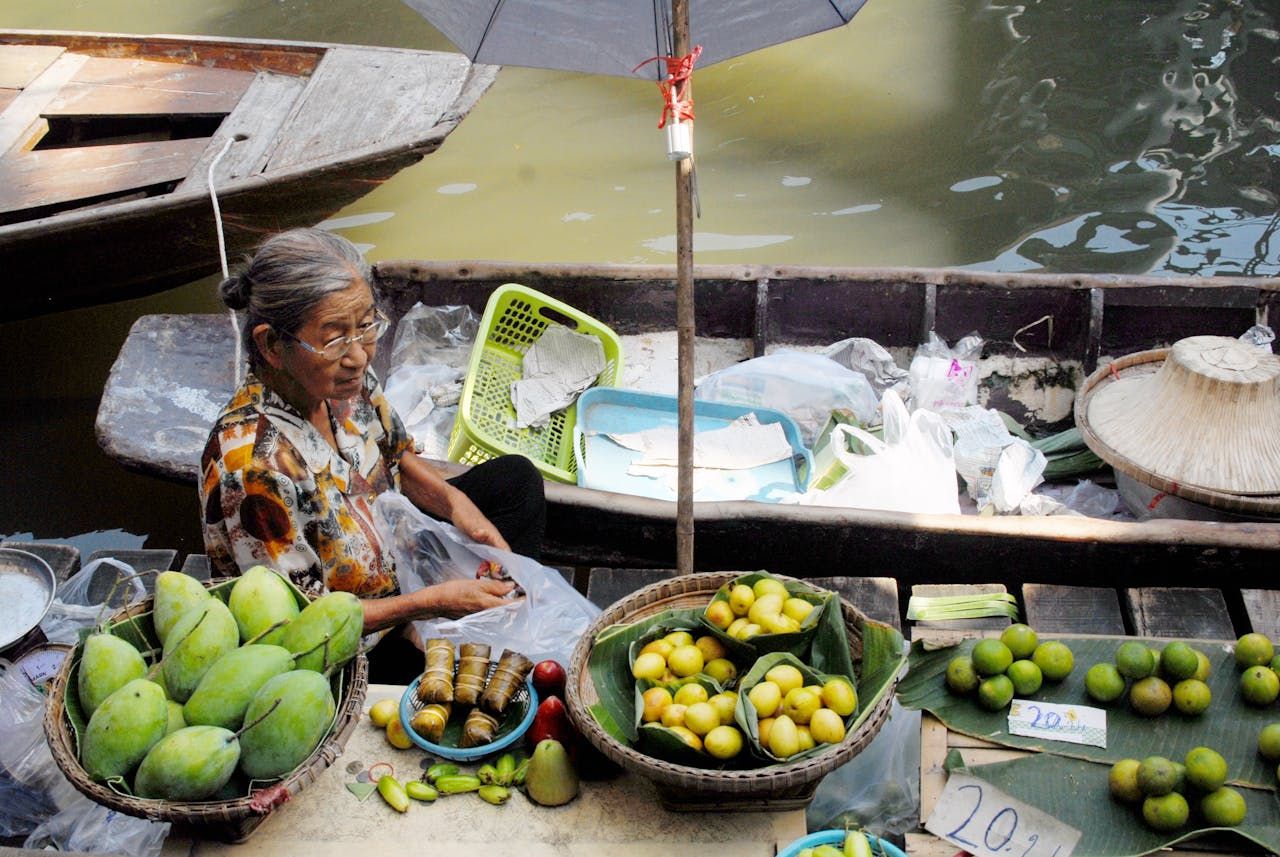
Go early. Every market is better before 9 AM. The light is better for photos, the temperature is 5–10 degrees cooler, the food stalls are freshest, and the boats aren't competing for canal space with tour groups. At Damnoen Saduak specifically, 7–8:30 AM is the window that separates the memorable from the mediocre. If you're pairing a floating market with a weekend in the city, Chatuchak Weekend Market is the natural complement — it's one of the largest markets in Asia and runs on Saturdays and Sundays. Our guide to things to do at Chatuchak Market and the Chatuchak market map will help you navigate it without getting lost in the 15,000-stall maze.
Dress for the climate. Lightweight fabrics, a hat, and sunscreen are non-negotiable. On boat rides, there's no shade — a long-sleeved shirt helps more than sunscreen alone. Humidity on the water is higher than in the city.
Photography etiquette. Vendors are generally happy to be photographed, but always smile and make brief eye contact before pointing a camera. Buying something small from a vendor before photographing them is a good practice and costs almost nothing. At Tha Kha, the elderly vendors and monk ceremonies deserve particular respect — observe before shooting.
What to skip. The mass-produced fridge magnets, Thai elephant print t-shirts, and repackaged "local products" that appear at every tourist market. Instead, look for handmade coconut shell bowls, natural herbal soaps, fresh dried spices and chili pastes, and local snacks sold by weight. These are the things you won't find in Bangkok's malls. And if the floating market food leaves you wanting more, Bangkok's wider street food scene goes even deeper — including a handful of Michelin-starred street food stalls that cost less than a sit-down restaurant.
If you're prone to motion sickness. The long-tail boats used for canal tours are fast, loud, and occasionally choppy. Take medication beforehand if needed, and sit toward the front for a smoother ride.
Ready to Book?
Every market on this list has a corresponding Klook tour — from half-day city market options to full-day combo trips. Browse Bangkok floating market tours on Klook, filter by date and market, and book with free cancellation up to 24 hours before departure.
The boats leave early. Set your alarm.